

Key Points:
- Glass countertops are non-porous, custom-designed, and hygienic, but come at a higher price with limited fabricator availability.
- Quartz offers the most durability and consistency for the money, while granite delivers natural, one-of-a-kind character but needs regular sealing.
- The right choice depends on priorities: modern low-maintenance design (glass), everyday durability (quartz), or natural variation (granite).
Choosing a countertop material feels simple until you actually start comparing options. Granite, quartz, glass — they all look great in photos. But which one actually fits your kitchen, your budget, and your lifestyle?
If glass countertops have caught your eye, you’re probably wondering: how does it really stack up against quartz and granite?
Let’s break it down honestly — pros, cons, and everything in between.
Glass Countertops: The Pros and Cons
Let’s start with the material that’s turning heads lately.
The pros:
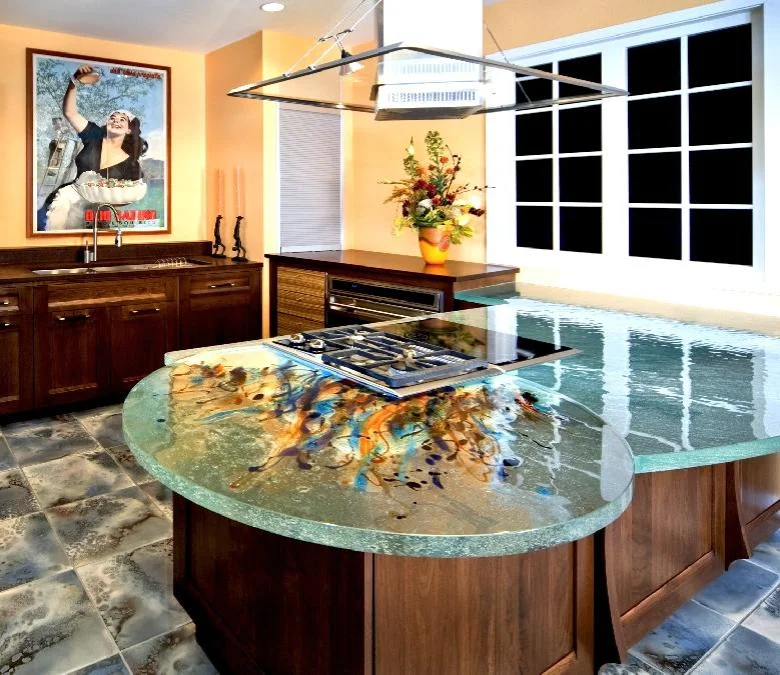
- Stunning, modern aesthetic. Glass countertops offer a sleek, reflective look you simply can’t get with stone.
- Non-porous surface. Unlike granite, glass doesn’t absorb liquids, making it naturally resistant to stains and bacteria.
- Customizable. Glass can be colored, textured, or backlit for a truly unique design.
- Eco-friendly options. Many glass countertops are made from recycled glass.
The cons:
- Higher price point compared to some granite options.
- Visible fingerprints and smudges on certain finishes (though this varies by texture).
- Limited availability — not every fabricator specializes in glass countertops.
Here’s the thing worth remembering: glass isn’t just a “look” — it’s a genuinely low-maintenance, hygienic surface that happens to look incredible too.
Quartz Countertops: The Pros and Cons
Quartz has become the go-to for a reason. Let’s see how it compares.
The pros:
- Extremely durable and resistant to scratches and chips.
- Non-porous, similar to glass, so it resists stains without needing regular sealing.
- Consistent patterns, since it’s engineered rather than natural.
- Wide availability across price points and styles.
The cons:
- Can look less “natural” compared to granite’s organic variation.
- Heat sensitivity — quartz can be damaged by very hot pans.
- Price varies widely depending on brand and design.
Quartz is often the “safe middle ground” — durable, low-maintenance, and widely available, without the higher price tag glass sometimes carries.
Granite Countertops: The Pros and Cons
Granite has been a kitchen staple for decades. Here’s why — and where it falls short.
The pros:
- Natural, one-of-a-kind patterns — no two slabs look exactly alike.
- Heat resistant, making it a favorite for cooking-heavy kitchens.
- Long-lasting when properly sealed and maintained.
The cons:
- Porous surface that requires regular sealing to prevent staining.
- Can crack or chip if heavy objects are dropped on it.
- Maintenance-heavy compared to quartz or glass.
Granite remains a solid choice for homeowners who love natural variation and don’t mind the extra maintenance that comes with it.
Side-by-Side: Which One Actually Fits Your Kitchen?
So how do these three stack up when placed side by side?
- Best for modern, low-maintenance design: Glass
- Best for durability and consistency: Quartz
- Best for natural, timeless character: Granite
On maintenance: Glass and quartz both win here, since neither requires sealing. Granite needs more upkeep to stay stain-resistant.
On uniqueness: Granite and glass both offer one-of-a-kind visual appeal — granite through natural stone variation, glass through custom colors and finishes.
On budget: Quartz tends to offer the widest range of price points, while glass and high-end granite can trend higher depending on customization.
The real answer? There’s no universally “best” option — just the best fit for your kitchen’s style and your household’s habits.
Making the Right Choice for Your Home
At the end of the day, choosing between glass, quartz, and granite comes down to a few honest questions:
- Do you prioritize a modern look or natural variation?
- How much maintenance are you willing to do?
- Is heat resistance a daily concern in your kitchen?
- Does your budget favor consistency (quartz) or customization (glass)?
If a sleek, non-porous, custom-designed surface sounds like the right fit, glass countertops are worth serious consideration — and that’s exactly where The Glass House can help.
We work with homeowners to design custom glass countertops that fit their kitchen’s style, from color and texture to backlighting options that make a real design statement.
Curious if glass is the right choice for your space? Reach out to The Glass House for a free consultation and let’s talk through your options.