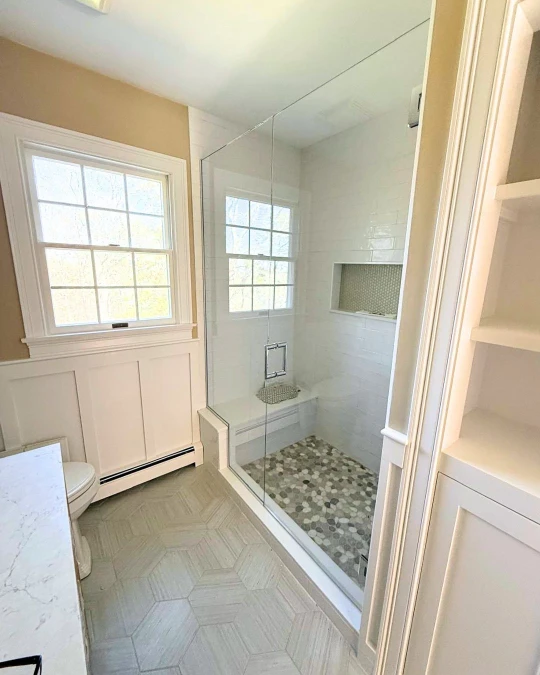

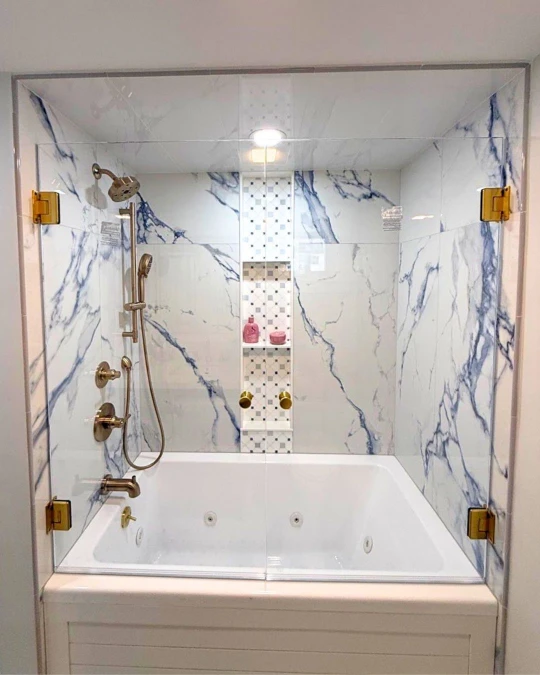

Choosing a hardware finish for a frameless shower enclosure is a bigger decision than it looks like on a spec sheet. There’s no surrounding channel or frame to soften the choice every hinge, clamp, and handle sits directly against glass and tile, fully visible from every angle of the room. Get the finish right and it reads as intentional architecture. Get it wrong — or mix it inconsistently with your plumbing fixtures and it reads as an afterthought, no matter how good the glass and tile are.
As we note in our Complete Guide to Custom Glass Shower Doors & Enclosures: “In a frameless glass shower enclosure, the hardware is not background infrastructure it is foreground architecture.” The pillar guide outlines five standard finishes; this guide expands each one with the maintenance reality fingerprints, water spotting, how it actually looks after six months of daily use and how to pair it correctly with plumbing fixtures and tile.
Because frameless hardware has no surrounding metal channel to hide it, the finish you choose functions as visible architecture, not a minor fixture detail. The pillar guide outlines five standard finishes matte black, brushed nickel, polished chrome, satin brass, and gunmetal/oil-rubbed bronze and this guide expands each one with maintenance reality and how it should pair with plumbing fixtures.
Why Hardware Finish Matters More in Frameless Installations
In a framed shower door, most of the metal is a border — a channel that surrounds the glass but rarely draws the eye on its own. In a frameless enclosure, that border is gone, and the hinges, pivots, and clamps that used to disappear into a frame now sit in open air, in direct visual dialogue with your plumbing fixtures, cabinet hardware, and tile detailing. There’s no design decision left to make later; the finish is foreground architecture from the day the glass goes in.
- Matte Black
- Brushed Nickel
- Polished Chrome
- Satin Brass
- Gunmetal / Oil-Rubbed
⚙️The Cardinal Rule, Restated
As covered in Chapter 4 of our Complete Guide Hardware Finishes & Architectural Details every metal finish in a bathroom should come from the same finish family. Mixing brushed nickel hinges with polished chrome faucets and matte black towel bars is the most common, most costly-looking mistake in bathroom design.
Matte Black: Best For Maintenance Reality
Matte Black
Most Requested
The dominant choice in contemporary and transitional bathrooms over the past five years. The flat, light-absorbing surface reads with strong graphic clarity against white tile or pale stone and pairs naturally with black plumbing fixtures and linear floor drains.
- Best For: Contemporary & transitional bathrooms, black fixtures
- Maintenance Reality: Highly resistant to visible water spotting; matte texture hides fingerprints well
The one caveat: on very hard well water left untreated for months, matte black can develop a faint dusty mineral haze rather than sharp visible spots still far less noticeable than on a polished finish, and it wipes off easily with routine cleaning.
Brushed Nickel: Best For Maintenance Reality
Brushed Nickel
The Perennial Choice
A warm grey-silver tone that’s broadly compatible with both cool and warm palette bathrooms. Its quiet understatement suits the New England aesthetic of restrained refinement, and it’s the finish we get the fewest “does this still look good in ten years” questions about.
- Best For: Broadly compatible palettes, long-term neutrality
- Maintenance Reality: Does not show fingerprints aggressively; moderate water-spot visibility
Brushed nickel ages gracefully rather than looking dirty the brushed texture naturally diffuses light in a way that camouflages minor wear, which is part of why it remains the safest long-term choice for homeowners who don’t want to think about finish maintenance at all.
Polished Chrome: Best For Maintenance Reality
Polished Chrome
Sharpest Clarity
The sharpest, most mirror-like finish, and exceptional in bathrooms with a crisp, architectural aesthetic particularly those with large-format white tile and minimal ornamentation. Its visual impact for clarity and precision is unmatched by any other finish on this list.
- Best For: Crisp architectural bathrooms, large-format white tile
- Maintenance Reality: Requires more diligent maintenance to keep fingerprint-free
That last line is straight from our pillar guide, and it’s worth taking literally: a mirror finish shows every water spot and fingerprint immediately, and on hard well water it can need a near-daily wipe-down to keep its signature clarity. Choose chrome because you genuinely want that sharpness not because it was the default option and be honest with yourself about whether you or a cleaning service will keep up the maintenance.
Satin Brass & Gunmetal: Best For Maintenance Reality
Satin Brass / Unlacquered Brass
Warmth & Character
The choice for warmth, richness, and a slightly eclectic character. Pairs beautifully with warm stone travertine, sandy limestone, honey-toned marble creating an effect of effortless, sun-washed luxury against whitewashed coastal tile.
- Best For: Warm stone pairings, eclectic & coastal-luxury interiors
- Maintenance Reality : Designed to patina tone shifts over years; this is a feature, not a flaw
Gunmetal / Oil-Rubbed Bronze
Deep & Tailored
Deep, complex, and distinctly tailored. Suits bathrooms with a more layered, curated aesthetic dark stone, aged wood vanities, or a distinctly masculine design direction.
- Best For : Layered, curated aesthetics, dark stone & wood
- Maintenance Reality : Dark tone camouflages fingerprints & spotting similarly to matte black
If living-finish patina makes you nervous, ask about lacquered or PVD (physical vapor deposition) brass instead of unlacquered it trades the evolving character of natural brass for a consistent, fixed appearance, which some homeowners prefer and others consider missing the entire point of choosing brass in the first place.
Matching Hardware Finish to Plumbing Fixtures and Tile
Most major plumbing manufacturers now offer matching finishes across faucets, shower systems, and accessories in black, nickel, chrome, brass, and bronze which makes family-matching straightforward if you commit to one finish before ordering anything. The mistake to avoid is choosing shower glass hardware first and plumbing fixtures later (or vice versa) without checking that both are available in the same finish family from compatible manufacturers.
- If you want an intentional mixed-metal look – a genuine, growing trend confine the accent metal to one category only, such as cabinet pulls or a single light fixture, rather than mixing it into the shower hardware itself.
- Tile undertone matters as much as color – Cool white tile with blue-grey undertones favors nickel or chrome; warm white or cream tile favors brass or matte black.
- Order hardware and plumbing fixtures from the same production run when possible – Finish batches can vary subtly between manufacturing runs, and a “matching” nickel from two different suppliers can read as two different metals under bathroom lighting.
How Coastal Air Affects Finish Longevity
Homes close to the water which describes a meaningful share of the properties we work on across Cape Cod introduce a variable that inland bathrooms don’t deal with: airborne salt. Even indoors, elevated ambient humidity and salt content can accelerate the natural aging process of some finishes faster than a standard interior environment would.
- PVD (physical vapor deposition) coatings hold up best – The molecular-level bonding process resists pitting and oxidation far better than standard electroplated finishes, regardless of proximity to the water.
- Matte black and gunmetal tend to age most gracefully – in coastal environments their dark tone already camouflages the subtle surface changes that salt-air exposure can accelerate.
- Unlacquered brass will patina noticeably faster near the water – If you’ve chosen brass specifically for its living finish, this simply happens on an accelerated timeline in an ocean-facing bathroom worth knowing going in, not a defect to be surprised by.
- Polished chrome shows the earliest signs of accelerated wear – in high-salt-air bathrooms, on top of its already higher fingerprint-maintenance requirement worth factoring in if your primary bath faces the water directly.
Hardware finish is one of the few decisions in a frameless shower project that’s genuinely difficult to change after installation which is exactly why it deserves the same upfront consideration as glass type and configuration. For the complete picture on how hardware fits alongside glass thickness, coatings, and structural anchoring, revisit Chapter 4 of our Complete Guide to Custom Glass Shower Doors & Enclosures.