
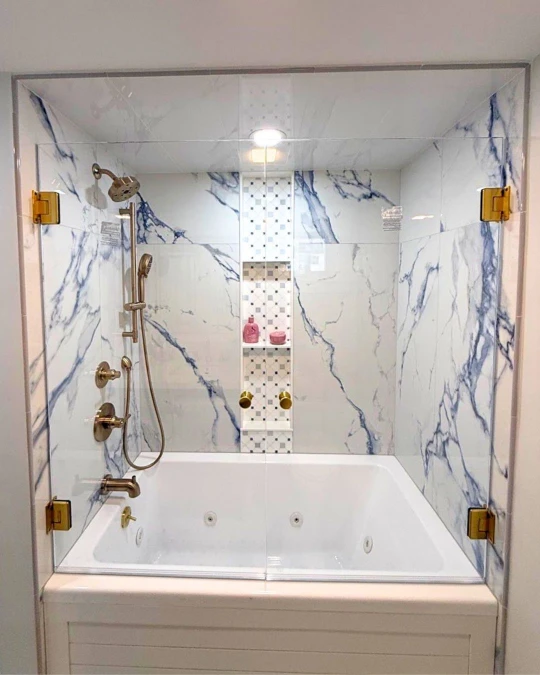


Here’s a detail most homeowners never think to ask about when hiring a glass contractor: what, exactly, is your shower door hardware actually anchored into? It’s a fair question, because the honest answer for a meaningful share of installations including some done by reputable-seeming companies is “mostly drywall, with a bit of luck.”
A single frameless shower hinge carries roughly 80–100 lbs of tempered glass, cantilevered off the wall at the panel’s edge. So how much weight can a wall stud hold? A single 2×4 stud, properly fastened, can support several hundred pounds of static, evenly distributed load but a cantilevered hinge load isn’t evenly distributed, and drywall alone, without a stud or blocking behind it, isn’t rated for anything close to that weight. Which is exactly why proper anchoring into a structural stud or dedicated blocking isn’t a nice-to-have upgrade. It’s the difference between a door that performs safely for decades and one that’s a slow-motion structural failure waiting to happen.
Frameless shower hardware carries 80–100 lbs of glass at concentrated anchor points, and drywall alone isn’t rated for that load. Proper installation requires anchoring into structural studs or dedicated blocking a step that’s easy to skip and hard for a homeowner to verify after the fact, which is exactly why it’s worth asking about before hiring anyone.
What Proper Wall Anchoring Actually Requires
The question of how much weight a wall stud can hold only matters once you know what’s actually behind the wall. As covered in Chapter 4 of our Complete Guide, hardware carrying 80–100 lbs of tempered glass must anchor into structural wall studs or solid blocking 2× lumber or 3/4″ plywood sheathing installed between studs not merely into tile and drywall. Standard drywall anchors and toggle bolts are rated for pull-out loads far below what a sustained, cantilevered hinge load demands; they’re built for towel bars and picture frames, not structural glass hardware.
This is a detailed enough topic that we’ve written a full technical breakdown of it including the actual weight math for different panel sizes, exactly where blocking needs to go for different hardware types, and what to tell a framer before rough-in, in our companion guide, Structural Blocking for Glass Hardware: A Builder’s Reference. The short version that matters most as a homeowner: if your installer can’t tell you confidently what’s behind your wall at each anchor point, that’s the problem this whole guide is about.
What Happens When It’s Done Wrong
This doesn’t need exaggeration to make the point the factual consequences are serious enough on their own.
The Gradual Version
Anchors Work Loose Over Time
Drywall anchors under sustained cantilevered load slowly work loose rather than failing all at once the door begins to sag, hinges loosen, and the panel drifts out of alignment over months, often first noticed as a door that no longer closes flush.
The Serious Version
The Anchor Point Fails Outright
If an anchor point fails completely rather than gradually loosening, the consequence isn’t a door falling off a hinge it’s the entire tempered glass panel separating from the wall. Tempered glass is engineered to shatter into small, relatively blunt fragments on failure rather than large shards, which is a genuine safety feature, but a falling panel is still a serious hazard regardless of how the glass itself breaks.
There’s also a quieter, more common consequence worth mentioning: warranty and liability exposure. If a hinge anchor fails and it’s later determined the wall wasn’t properly blocked, that’s typically treated as an installation defect rather than a covered hardware failure meaning the homeowner, not the manufacturer, often absorbs the cost of the fix.
How The Glass House Verifies Structural Integrity Before Fabrication
As we state directly in our pillar guide: “In our pre-installation site assessment, we identify stud locations and confirm the structural integrity of all anchor points. Where blocking is absent, we will specify its addition before fabrication proceeds. This is not optional.“
- We verify stud and blocking locations physically, not just electronically: A stud finder is a starting point, not a final answer we confirm anchor points before glass is ever measured or cut.
- We document what we find: Anchor point locations are recorded as part of our measurement report, reviewed by our fabrication team before any glass is fabricated.
- If blocking is missing, we say so before installation, not during it: We specify the addition of blocking as a required step before fabrication proceeds, rather than installing hardware into an anchor point we haven’t verified.
None of this is a marketing flourish it’s the same standard covered in our Structural Blocking guide, applied consistently on every installation we do.
Questions to Ask Any Glass Contractor Before Hiring Them
These are useful questions to ask any glass installer you’re evaluating not just us. A contractor confident in their process should be able to answer all of them clearly and specifically.
The Vetting Checklist
Ask before signing anything:
- “Do you verify stud or blocking locations on-site before installation, or do you assume standard framing?”
- “What’s your process if you find inadequate blocking behind the wall?”
- “Is structural verification included in my quote, or would remediation be billed as a change order later?”
- “Can I see documentation of anchor points before the glass goes in?”
- “What’s your policy if a hinge anchor fails after installation is that covered, or is it treated as a separate repair?”
A vague answer to any of these or a contractor who seems surprised by the question is worth taking seriously before you commit.
Wall anchoring is one of the least visible parts of a shower glass installation, and exactly for that reason, it’s the detail worth asking about directly before you hire anyone. For the complete hardware standard behind every project we fabricate, revisit Chapter 4 of our Complete Guide to Custom Glass Shower Doors & Enclosures.