
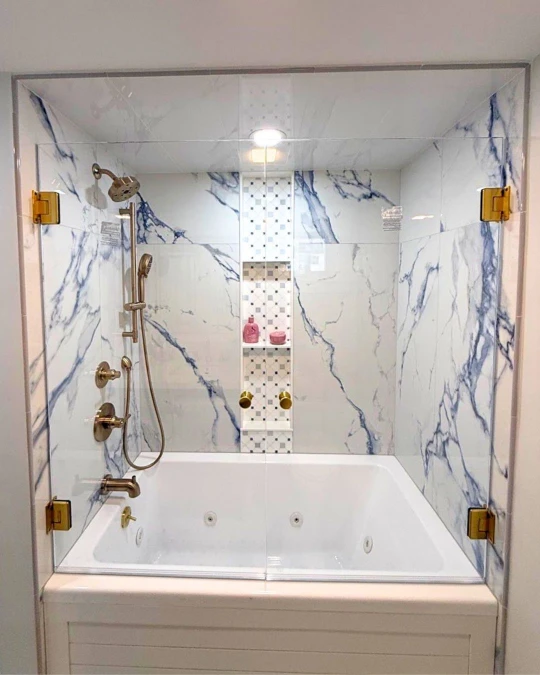


Low-iron glass isn’t more prone to hard water spotting than standard clear but it shows spotting more honestly, because there’s no green cast to camouflage it. Here’s what that actually means for how you clean and maintain your enclosure.
📖New to the low-iron decision? Start with Low Iron Glass vs. Clear: A Visual & Technical Comparison.
If you’ve already chosen or already own low-iron shower glass, the questions shift from “which one looks better” to “how do I keep it looking that way.” Cape Cod’s well water and municipal supplies both carry enough dissolved calcium and magnesium to leave visible deposits on any shower glass, and low-iron’s superior clarity changes how those deposits actually look, even though it doesn’t change how they form.
💧The Short Answer
Mineral deposits form identically on low-iron and standard clear glass the water chemistry doesn’t know the difference. What changes is visibility: low-iron’s water-clear surface shows spotting with sharper contrast, since there’s no green tint to blend it into. That makes a hydrophobic coating more valuable on low-iron glass, not less.
Are Mineral Deposits More or Less Visible on Low-Iron Glass?
More visible and it surprises some homeowners after they’ve paid a premium for clarity. The logic is straightforward: standard clear glass carries a faint green cast that provides a small amount of visual camouflage against white, cloudy mineral residue. Low-iron glass has no such cast. Every water spot, streak, and film sits against a perfectly neutral, water-clear background, which means it reads with more contrast, not less.
This isn’t a flaw in the glass it’s simply what “more clarity” means in practice. The same principle that makes low-iron glass disappear against white tile also makes it less forgiving of anything sitting on its surface.
Does Low-Iron Glass Show Water Spots Differently Than Standard Clear?
The spots themselves are chemically identical on both glass types calcium carbonate and magnesium deposits left behind as hard water evaporates from the surface. What differs is contrast, not chemistry.
| Factor | Standard Clear Glass | Low-Iron Ultra-Clear Glass |
|---|---|---|
| Mineral deposit formation | Identical | Identical |
| Visual contrast of spotting | Slightly masked by green cast | Sharper, more visible |
| Etching risk from abrasive cleaning | Same risk | Same risk |
| Benefit from hydrophobic coating | Meaningful | More noticeable improvement |
Recommended Cleaning Frequency & Products for Each Glass Type
Because the underlying maintenance need is the same for both glass types, our recommendations don’t differ by iron content they differ by whether the glass is coated.
Uncoated Glass (Low-Iron or Standard Clear)
- After every shower: A quick squeegee pass removes most standing water before it has a chance to evaporate and leave mineral residue.
- 2–3 times per week: A full wipe-down with a pH-neutral, non-abrasive glass cleaner and a soft microfiber cloth.
- Avoid: Ammonia-based glass cleaners, abrasive powders, steel wool, or scouring pads — all can dull the surface or create micro-scratches that trap future residue.
EnduroShield-Coated Glass
- After every shower: Often unnecessary water beads and runs off the treated surface rather than sheeting and evaporating in place.
- 1–2 times per week: A brief wipe with a soft cloth and warm water is typically sufficient to maintain a clean appearance.
- Avoid: The same abrasive products listed above, plus any acidic cleaner not rated as coating-safe these can strip the hydrophobic layer prematurely.
How EnduroShield Changes Maintenance for Both Glass Types
As covered in our EnduroShield coating guide, the treatment bonds to the glass surface at a molecular level, creating a hydrophobic and oleophobic barrier the coating doesn’t interact with iron content, so it performs the same way on low-iron and standard clear glass.
The practical difference is in how much of an improvement you’ll notice. On standard clear glass, the coating reduces visible spotting against an already slightly tinted background. On low-iron glass, the improvement is more dramatic simply because uncoated low-iron glass shows spotting more starkly to begin with meaning the “before and after” is more noticeable on the very glass you paid extra for its clarity.
🏛️The Glass House Recommendation: We consider EnduroShield a non-optional pairing with low-iron glass in Cape Cod’s coastal communities, where mineral content in both well water and municipal supplies is common. Skipping the coating on low-iron glass is where homeowners most often end up disappointed with a product that was never the problem the water was.
DIY Hard Water Spot Removal Without Damaging the Surface
Existing buildup can usually be removed safely at home, provided you avoid anything abrasive enough to scratch the glass surface a scratch, unlike a mineral deposit, is permanent.
- Rinse and assess – Light haze is usually fresh film; a chalky white crust signals longer-term calcium buildup that will need more contact time with a cleaner.
- Apply a glass-safe mineral remover – Use a cleaner formulated for hard water deposits on glass, or a diluted white vinegar solution. Avoid general-purpose bathroom cleaners not rated safe for glass.
- Let it sit for 3–5 minutes – To soften the deposit before you start wiping this reduces how much physical scrubbing pressure you need.
- Wipe with a soft, non-abrasive cloth – microfiber or a soft sponge only. Never steel wool, abrasive powders, or scouring pads.
- Rinse thoroughly and dry completely – With a squeegee or clean towel. Leftover moisture is exactly what creates the next round of spots as it evaporates.
- Reapply coating if water stops beading – On EnduroShield-treated panels, a loss of the water-beading effect after cleaning means the coating has worn thin and should be reapplied see our coating guide for reapplication guidance.
If a panel has years of untreated buildup that doesn’t respond to a glass-safe mineral remover, stop before reaching for anything more aggressive. Professional glass restoration exists precisely because DIY abrasives are the most common cause of permanent etching we see on service calls.