


One of the most common scheduling questions we get isn’t about glass type or hardware finish it’s simply: “when do you actually come measure?” It’s a fair question, because the answer isn’t “whenever convenient.” There’s a specific, narrow window in a bathroom renovation timeline where shower glass measurement belongs, and getting it wrong in either direction creates real problems.
As we note in our Complete Guide to Custom Glass Shower Doors & Enclosures: “The ideal point for scheduling an on-site measurement is after tile installation is complete and grouted, but before any plumbing fixtures or glass are installed.” This guide unpacks exactly why that window exists, what goes wrong on either side of it, how new construction adds an earlier checkpoint of its own, and a simple timeline checklist you can hand to your GC.
Measuring too early (before tile) leaves the real dimensions unknown; measuring too late (after plumbing fixtures go in) creates access problems. There’s a specific renovation-timeline window, and new-construction projects need blocking coordinated with the builder even earlier.
The Exact Window: After Tile, Before Fixtures
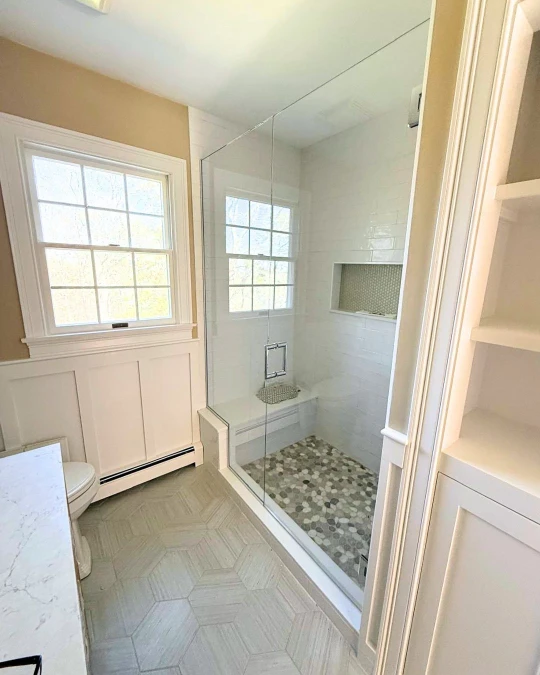
The window exists for two independent reasons that happen to land in the same place on the calendar. Tile installation is what finalizes the true dimensions of your shower opening tile thickness, grout lines, curb height, and finished wall surface are all baked in only once tile is set and grouted. Measuring before that point means measuring dimensions that are still going to change.
On the other end, plumbing fixtures the valve trim, shower arm, handheld bracket, freestanding tub filler physically occupy the same wall space a laser measurement needs clear access to. Once they’re installed, our technicians are measuring around finished chrome or matte black trim instead of a clean, open wall, which slows the visit and risks marking or bumping fixtures that are already in their final position.
📅In Practice
Call to schedule your measurement as soon as your tile setter gives you a grout-cure completion date typically 24–72 hours after grouting, depending on the product used. That’s usually the exact moment the window opens.
What Goes Wrong If You Measure Too Early
Measuring before tile is set means measuring a space that hasn’t reached its finished dimensions yet and every one of the following variables can still shift after that measurement is taken:
- Tile thickness varies: Anywhere from roughly 1/4″ for standard ceramic to 3/8″–1/2″ or more for natural stone and that thickness adds directly to the finished opening’s dimensions in ways drawings rarely account for precisely.
- Curb height and slope aren’t finalized: Until the tile setter builds the actual mud bed and slope, which directly affects where hardware anchors and how the panel meets the floor.
- Wall surface and plumb reading can still change: As backer board, waterproofing membrane, and tile are applied in sequence as covered in our out-of-plumb walls guide, the true plumb reading only exists once the wall is in its final, finished state.
Glass fabricated from a pre-tile measurement is, functionally, the same problem as glass fabricated from a drawing or an estimate: it’s built to a dimension the room hasn’t actually reached yet.
What Goes Wrong If You Measure Too Late
Waiting until after plumbing fixtures are installed feels intuitive “let’s get everything else finished first” but it introduces a different set of problems:
- Fixtures block clear sightlines: For laser measurement at exactly the reference points that matter most: wall plumb near the valve, floor level near the drain, and anchor zones near a wall-mounted rain arm.
- Risk to finished trim: Measuring equipment and technicians working around already-installed chrome or matte black hardware raises the chance of a scratch or ding on a fixture that can’t easily be swapped without disassembly.
- Sometimes fixtures need temporary removal: To get an accurate reading, which means coordinating your plumber back to the job site an added scheduling step and cost that measuring at the right time avoids entirely.
The fix here isn’t complicated: hold off on the plumbing fixture install until after your glass measurement visit, even if everything else is ready to go.
New Construction: Coordinating Blocking Before Tile
New-construction projects have a second checkpoint that renovations of an existing bathroom don’t: structural blocking for the glass hardware has to go in during framing, well before tile is ever set not at the post-tile measurement stage described above.
We cover this in full in our Structural Blocking for Glass Hardware: A Builder’s Reference the short version is that a hinge carrying 80–100 lbs of tempered glass needs solid blocking anchored into studs, and that blocking has to be coordinated with your framer before drywall closes the wall up. Waiting until the post-tile measurement visit to think about blocking is too late by then, the wall is already finished and adding blocking means cutting it back open.
In practice, new construction has two separate touchpoints on the calendar: a framing-stage call to confirm blocking locations, and the standard post-tile, pre-fixture measurement visit everything else in this guide describes.
A Simple Renovation Timeline Checklist
Here’s the full sequence, with the measurement window clearly marked:
- Demo of the existing bathroom (if applicable)
- Rough plumbing & electrical
- Structural blocking installed for glass hardware (new construction or major remodel coordinate this with your framer, not with us at measurement stage)
- Insulation, vapor barrier & drywall or backer board
- Waterproofing membrane
- Tile installation & grout cure
- Schedule your shower glass measurement
- Glass fabrication (while the rest of the bathroom finishes elsewhere)
- Plumbing fixture installation
- Glass installation
Hand this list to your GC or tile contractor early the single most common delay we see isn’t in our own fabrication timeline, it’s a plumbing fixture install scheduled a week before the measurement visit instead of a week after.
Getting the measurement window right costs nothing and saves real time it’s a scheduling decision, not a technical one. For the complete measurement standard behind every project we fabricate, revisit Chapter 5 of our Complete Guide to Custom Glass Shower Doors & Enclosures.