
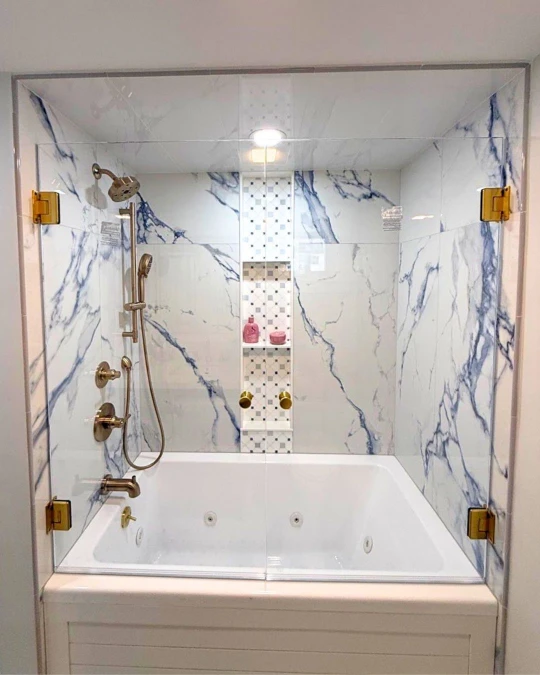


Most bathroom renovation conversations focus on what you’ll see every day tile, glass, hardware finish. Two structural conditions rarely come up at all, precisely because they disappear from view the moment tile goes down: the shower curb or ledge, and what’s anchoring the glass hardware behind the wall. Both are easy to get wrong, both are expensive to fix after the fact, and both are worth understanding in plain terms before your project reaches the point of no return.
A shower curb or ledge needs a slight, consistent slope toward the shower interior even a fraction of a degree in the wrong direction lets water migrate onto the bathroom floor. Separately, hardware carrying 80–100 lbs of tempered glass needs to anchor into structural studs or blocking, not tile and drywall alone. Both conditions are set before tile is finished and are difficult to correct afterward.
Curb vs. Ledge: What’s the Difference?
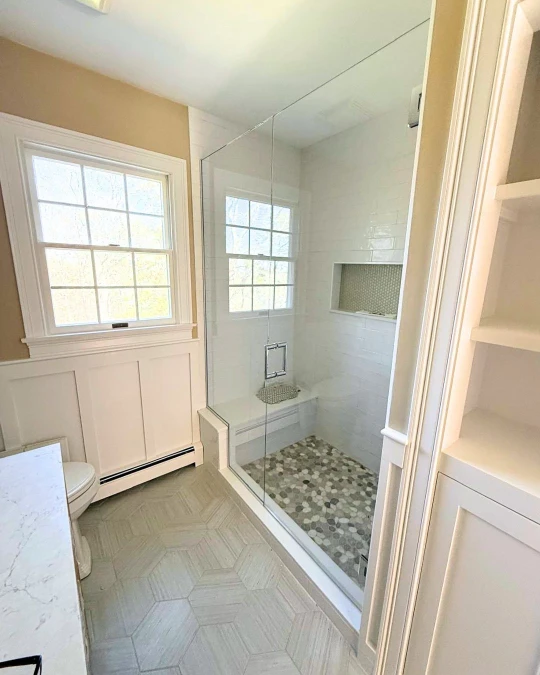
Contractors use these two terms somewhat interchangeably, which understandably confuses homeowners comparing quotes. A curb is a raised threshold typically 2″–9″ tall that you step over to enter the shower, creating a physical barrier that contains water inside the shower pan. A ledge generally refers to the same raised lip once it’s finished in tile, particularly when it’s built low and wide enough to also function as a small seat or shelf at the shower’s edge.
A zero-threshold or curbless transition removes this raised element entirely, relying instead on floor slope alone to contain water a fundamentally different structural approach covered in depth in our companion guide on wet room and fixed-screen layouts. Whether your project uses a curb, a ledge, or a curbless transition should be decided early, since it affects framing, waterproofing, and tile layout well before the glass is ever measured.
Why Slope Direction Matters
A curb or ledge isn’t a flat surface it needs a slight, consistent slope from its outer edge back down toward the shower interior. This isn’t a finishing nicety; it’s the entire reason the curb contains water in the first place. Water that lands on top of the curb during a shower needs somewhere to go, and that somewhere has to be back into the shower pan, not out onto the bathroom floor.
A curb sloped flat, or sloped even slightly in the wrong direction, defeats its own purpose regardless of how tall it is. This is a common, easy-to-miss error precisely because it’s invisible to the eye a curb can look perfectly level and finished while still directing water the wrong way, and the only way to catch it is to check with an actual level during construction, not after tile is grouted.
What Happens When It’s Built Wrong
An incorrectly sloped curb doesn’t announce itself right away the consequences build quietly, over months.
❌ Reverse or Flat-Sloped Curb
Water Migrates Into the Subfloor
Water directed onto the bathroom floor instead of back into the pan seeps at the tile-to-curb joint over time, working into the subfloor below. This often goes unnoticed until soft flooring, discoloration, or a musty smell appears well after the damage has started.
✓ Properly Sloped Curb
Water Stays Contained
A curb verified with a level during construction, sloping consistently back toward the shower interior, keeps water where it belongs for the life of the installation no ongoing risk to the subfloor beneath.
The eventual repair for subfloor water damage is disproportionate to how small the original mistake was it typically means removing tile, replacing damaged subfloor material, and rebuilding the curb correctly, all to fix an error that would have cost nothing to catch with a level before tile went down.
Wall Anchoring: Why Studs Matter More Than Tile
The second invisible condition has nothing to do with water. Frameless glass hardware particularly hinges carrying 80–100 lbs of tempered glass has to anchor into structural wall studs or dedicated blocking, not just tile and drywall. Tile provides a beautiful, waterproof surface; it provides essentially no structural holding power on its own.
This is detailed enough that we’ve written a full guide specifically on it Why Wall Anchoring Matters covering the weight math, what happens when it’s skipped, and questions worth asking any glass contractor. The short version for this guide: whatever is behind your shower wall at the anchor points matters as much as anything visible in the finished room.
What We Check During Site Assessment
Both conditions get verified before we ever cut glass, as part of the same visit:
- Curb and ledge slope: Checked with a level at multiple points along its length not assumed from the tile setter’s finished appearance alone.
- Curb height and width: Measured precisely, since these dimensions directly affect where the glass panel’s bottom edge and hardware need to sit.
- Stud and blocking locations behind the wall: Confirmed at every anchor point the hardware will use the full process is covered in our wall anchoring guide.
- Everything documented in our measurement report: Reviewed by our fabrication team before glass is ever ordered.
Questions to Ask Before Tile Goes Down
These two questions, asked at the right moment, catch the vast majority of curb and anchoring problems before they’re sealed behind tile:
Ask Your Tile Contractor or GC
Before the mud bed and tile are set:
- “What’s the finished curb height and slope direction, and has it actually been verified with a level not just eyeballed before the mud bed is set?”
- “Is blocking already in place behind this wall for the glass hardware, or does that still need to be coordinated before the wall closes up?”
A contractor who answers both clearly and specifically has thought this through. A vague or surprised response to either one is worth pausing on before tile makes the answer permanent.
Curbs, ledges, and wall anchoring share one thing in common: they’re the parts of a shower installation nobody notices when they’re done right, and everyone notices when they’re not. For the complete structural standard behind every project we fabricate, revisit Chapter 4 of our Complete Guide to Custom Glass Shower Doors & Enclosures.