
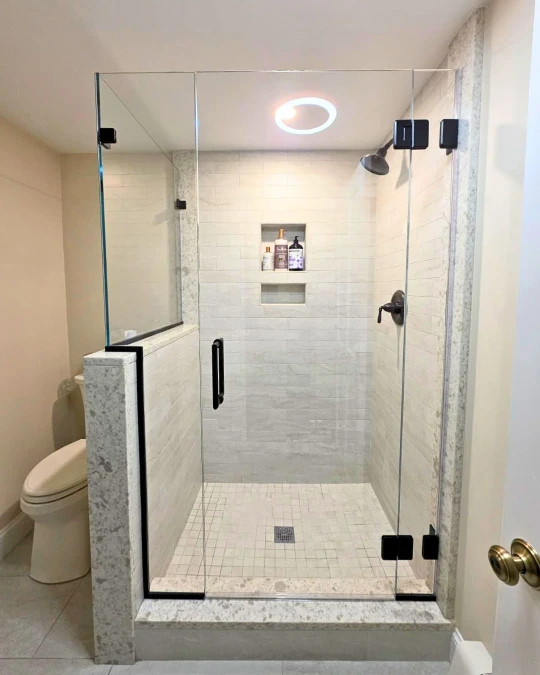
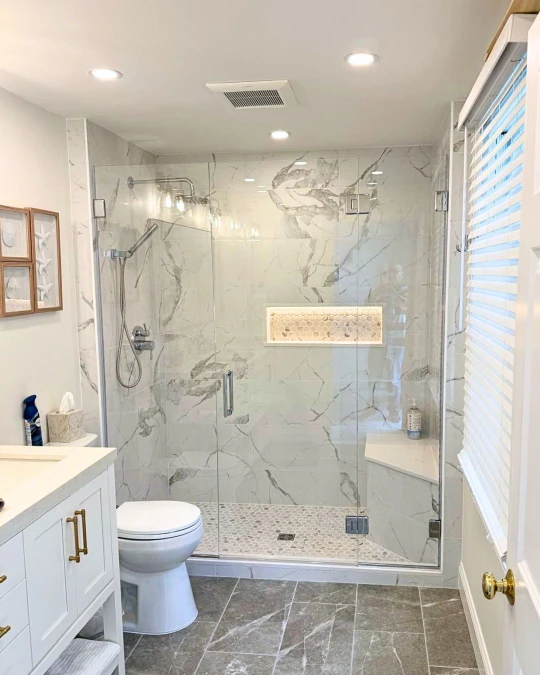
A curbless wet room typically adds $2,000 to $5,000 over a comparable curbed shower enclosure driven by four specific line items, not a single blanket “wet room upcharge.” Here’s exactly where that money goes.
📖Planning the layout itself? Start with Curbless Walk-In Showers & Wet Rooms: Planning Slope, Drainage & Fixed Glass Layout.
Once a homeowner decides a curbless wet room is the right direction for their bathroom remodel, the next question is inevitably about money. Unlike a standard shower pan, a wet room touches four distinct trades waterproofing, drainage, floor framing, and glass and each one carries its own incremental cost versus a conventional curbed enclosure. Understanding where that money actually goes is more useful than a single “wet rooms cost X% more” headline number.
💵A Note on These Numbers
The figures on this page are general industry ranges for custom bathroom remodeling, intended for budgeting and comparison not a quote. Your actual price depends on your specific contractor, existing floor structure, and site conditions. Book a free consultation for an exact number on your project.
Waterproofing Labor Cost vs. a Standard Shower Pan
A standard shower installs on a pre-formed pan or a mud-set pan with a contained CPE/PVC liner, waterproofing a relatively small, boxed-in footprint. A wet room requires a continuous waterproof membrane sheet or liquid-applied, as covered in our waterproofing membrane guide across the entire wet area floor, not just the shower footprint.
- Standard shower pan waterproofing labor: Typically $400–$800
- Full wet room floor waterproofing labor: Typically $1,200–$2,200
- Typical premium: +$700–$1,500
The larger surface area, the precision required at the drain connection, and the flood-testing step all add labor time that a contained shower pan doesn’t require.
Linear Drain Installation Cost vs. Point Drain
Wet rooms are frequently paired with a linear drain, since a single-direction slope to a linear drain is often easier to achieve across an open floor than a four-way slope to a central point drain though a point drain can work in a wet room too, and a linear drain can be used in a standard shower as well. The cost difference comes down to the fixture and the slope precision it requires, not the room type itself.
- Point drain (fixture + install): Typically $150–$300
- Linear drain (fixture + install): Typically $400–$900
- Typical premium: +$250–$600
Slope Framing & Floor Build-Up Cost
This is usually the largest single line item, and the one most dependent on whether you’re building new or retrofitting. A curbed shower contains its slope entirely within the pan itself, requiring minimal changes to the surrounding floor structure. A curbless wet room needs the slope-to-drain built into the actual floor framing often by recessing joists near the drain or building up the surrounding floor height to meet a lowered shower zone.
- New construction (framing planned from the start): Typically $800–$1,500 in additional framing and subfloor work
- Retrofit into an existing floor structure: Typically $1,500–$2,500, reflecting the added labor of modifying framing that’s already in place
This is also the item most likely to expand once a contractor opens the floor and finds a condition that wasn’t visible beforehand budgeting toward the higher end of the range is the more conservative approach for a retrofit.
Fixed Glass Panel Pricing vs. a Framed Door Alternative
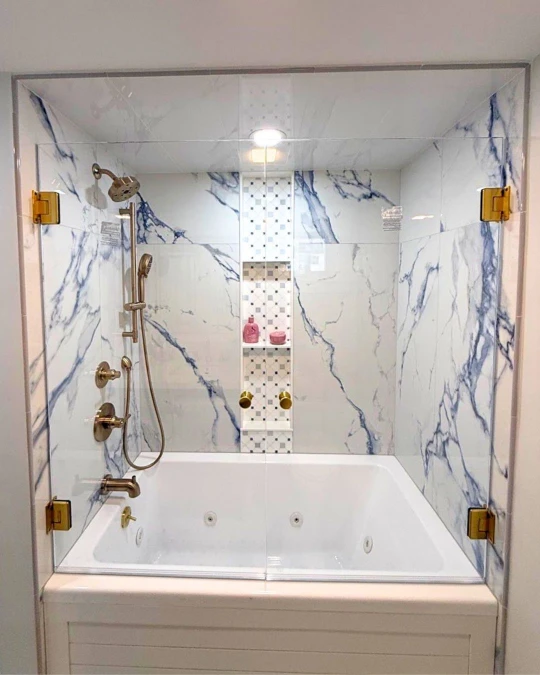
Wet rooms commonly use one or more large fixed glass panels rather than a swinging or sliding door, since there’s no curb or track to anchor a door to. A fixed panel is typically wall-clamp mounted rather than hinged, and because it’s often a single larger span of glass, per-square-foot pricing runs comparable to or slightly above a standard frameless hinged door while a basic framed door alternative remains the lowest-cost glass option, at the cost of a visible metal frame and channel.
| Glass Configuration | Typical Installed Cost | Notes |
|---|---|---|
| Framed swinging door | $40–$60/sq ft | Lowest cost, visible frame |
| Frameless hinged door | $65–$85/sq ft | Standard frameless baseline, 3/8″ |
| Fixed wet room panel | $70–$95/sq ft | Wall-clamp mounted, often a larger single span |
If low-iron glass is also being specified for the fixed panel a common pairing, since a large fixed span is exactly where iron tint is most visible see our low-iron cost breakdown for that additional premium on top of the base glass pricing above.
Total Premium Range vs. a Comparable Curbed Enclosure
Adding up the four components above against a baseline curbed frameless enclosure:
| Line Item | Typical Added Cost |
|---|---|
| Waterproofing | +$700–$1,500 |
| Drain (if upgrading to linear) | +$250–$600 |
| Slope framing / floor build-up | +$800–$2,500 |
| Glass (fixed panel vs. hinged door, per typical sq ft) | +$100–$400 |
| Typical Total Premium: $2,000–$5,000 | |
Against a baseline curbed frameless enclosure project of roughly $4,500–$9,000, this places a comparable wet room project in the general range of $6,500–$14,000 with the floor framing work, particularly in a retrofit, being the single biggest driver of where a given project lands within that range.
🏛️The Glass House Recommendation
The floor framing line item is where an accurate quote depends most on seeing your actual space an estimate given before opening the floor should always be treated as preliminary. We recommend a joint site visit with your general contractor before finalizing a wet room budget, specifically to assess what the existing floor structure will require.